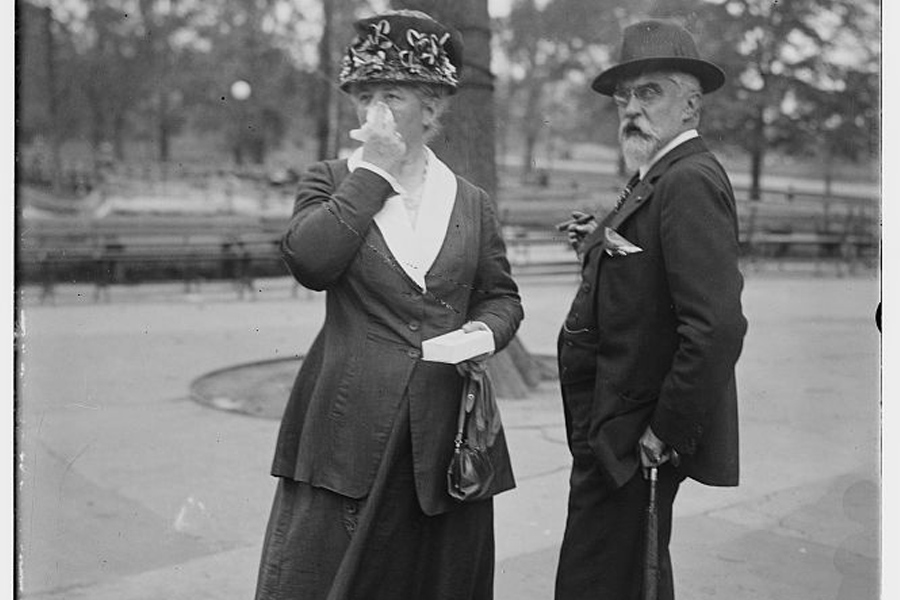
A woman shaped by wealth, lineage, and public life
I think of Louisa Pierpont Morgan as a figure standing at the polished center of the Morgan dynasty, where money, influence, and family duty all reflected one another like light in a ballroom mirror. Born in 1866, she entered a world already charged with power. Her father was J. P. Morgan, the towering financier who helped define American capital in the late nineteenth and early twentieth centuries. Her mother, Frances Louisa Tracy Morgan, brought New York social standing and family continuity into the household.
Louisa was the eldest child, and that mattered. In a family built on stature and expectation, the firstborn often becomes a kind of living introduction to the dynasty. She was not just a daughter. She was a visible part of the Morgan name, a presence in drawing rooms, summer estates, and the social theater of the Gilded Age. Her life was less about office work and ledgers than about inherited position, cultural influence, and the graceful management of a name that carried weight far beyond any one room.
Her later name, Louisa Satterlee, came after her marriage to Herbert Livingston Satterlee in 1900. That marriage linked her to a man who was himself accomplished, serving as a lawyer, writer, businessman, and Assistant Secretary of the Navy. Together they moved in elite circles, but Louisa always remained recognizably a Morgan. The old surname never quite loosened its hold. It followed her like a crest.
The Morgan household and the architecture of family
The Morgan family was pillared. As the oldest, Louisa occupied one corner, and her siblings each had their own weight.
Her brother John Pierpont Morgan Jr. was the likely financial heir. He took Morgan into a new century after inheriting the bank. If J. P. Morgan built the family fortune, his son maintained it. In contrast, Louisa did not run the bank. She was part of the family’s social and cultural sphere, where influence was discreet but strong.
Her sister Juliet Pierpont Morgan married William Pierson Hamilton, starting another prominent family. Juliet follows the Morgan pattern of planned social alignment, where marriage expanded a family story. Visibility, inheritance, and expectation defined Louisa and Juliet’s sisterhood.
Anne Tracy Morgan, the youngest sister, was possibly the most generous. She was famous for her humanitarian work during and after World War I. Anne and Louisa seemed to contrast in many ways. One grew increasingly visible in philanthropic work, while the other became a poised society figure, patron, and refinement icon.
Their parents, J. P. Morgan and Frances Louisa Tracy Morgan, built a prestige-filled home. A cultivar. Was inherited. It was accurately displayed. That climate raised Louisa. Her youth would have been more like a well-kept manor, with every path leading to duty, reputation, or alliance.
Junius Spencer Morgan and Juliet Pierpont Morgan were her Morgan grandparents. I value these names because they remind me that dynasties take time. The layers are stone-under-stone. Her Tracy grandparents were Charles and Louisa Kirkland Tracy. Her genealogy extended to elder family lines that gave the Morgans their American elite status.
Marriage, children, and the quieter power of domestic legacy
Louisa married Herbert Livingston Satterlee on 15 November 1900 in Manhattan. That date marks a major transition, but not a disappearance. She did not vanish into her husband’s shadow. Instead, she helped build a domestic and social world that was still distinctly Morgan in tone and scale.
The couple had two daughters. Mabel Morgan Satterlee, later Mabel Morgan Satterlee Ingalls, became a professor of bacteriology and a preservationist connected to Sotterley. Eleanor Morgan Satterlee later married Milo Sargent Gibbs. These daughters extended the family line into education, preservation, and new social networks.
Louisa’s own life as a mother would have been shaped by the expectations of her class. Wealth created freedom, but also performance. A house of this rank did not simply shelter people. It staged their lives. Children were raised within a setting where names, manners, estates, and marriages all mattered. In that sense, Louisa’s family life was part private affection and part public inheritance.
The Satterlee home became associated with land and property on a notable scale. J. P. Morgan bought a large tract as a wedding gift, and later the couple purchased Sotterley in Maryland. The family residence at this level was never only a house. It was a statement, a landscape of privilege. The grounds themselves seemed to speak.
Public presence, taste, and cultural memory
Louisa never built a corporate empire, but she is active. She participated in public culture through taste, influence, and patronage, according to her archives. Her 1898 christening of J. P. Morgan’s yacht Corsair III is notable. Small gestures with theatrical power turn affluence into ceremony.
She was also known for her criticizing Salome at the Metropolitan Opera in 1907. I remember that detail because it shows personality. She was more than decoration. She had opinions, which might be powerful in affluent New York culture. Criticizing an opera premiere in that world meant discussing art, morality, and social taste.
She reportedly participated in organized World War I humanitarian activities. That was common among wealthy women of her generation, who routinely gave back. Instead of elected position or corporate command, Louisa’s influence came from family reputation, social networks, and public service.
The family name after the age of steel and finance
The Morgan name is often attached to banks, railroads, trusts, and capital. Louisa reminds me that families are made of more than institutions. They are made of daughters, sons, spouses, and descendants who inherit not only money, but expectations.
Her brother J. P. Morgan Jr. carried the financial line forward. Her sister Juliet connected the family to another prominent household. Her sister Anne became a celebrated humanitarian. Her husband, Herbert, brought legal and governmental distinction. Her children carried the family into new professional and social realms. Even her descendants and family estates kept the Morgan story alive in altered form.
In a way, Louisa was a hinge. One side of her life opened onto the high machinery of finance through her father and brother. The other opened onto culture, marriage, estates, and family continuity. She stood between these worlds with poise. That is part of what makes her interesting. She was not the loudest Morgan, but she was one of the clearest mirrors of the family’s social power.
FAQ
Who was Louisa Pierpont Morgan?
Louisa Pierpont Morgan was the eldest daughter of financier J. P. Morgan and Frances Louisa Tracy Morgan. She later became Louisa Satterlee after marrying Herbert Livingston Satterlee in 1900.
What was her role in the Morgan family?
She was a central family figure, linked by birth to the Morgan banking dynasty and by marriage to Herbert Livingston Satterlee. She was also the sister of J. P. Morgan Jr., Juliet Pierpont Morgan, and Anne Tracy Morgan.
Did Louisa Pierpont Morgan work in finance?
No, she was not known as a banker or corporate executive. Her public life centered more on society, patronage, charitable work, and cultural influence.
Who were her children?
She had two daughters, Mabel Morgan Satterlee Ingalls and Eleanor Morgan Satterlee Gibbs.
What is Louisa Pierpont Morgan remembered for today?
She is remembered as a prominent Gilded Age heiress, a member of the Morgan family, a society figure, and a woman connected to major cultural and philanthropic circles in New York and beyond.